

Repossession Help Across Pennsylvania
Nationwide Repo helps banks, finance companies, dealerships, secured creditors, and individual lienholders coordinate repossession services throughout Pennsylvania. Files may involve autos, pickups, trailers, trucks, boats, RVs, machinery, or other collateral tied to a valid security agreement.
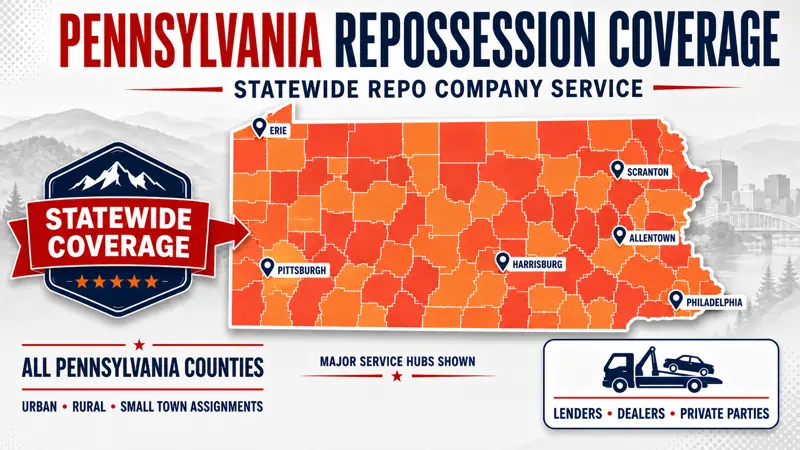
Recovery conditions shift quickly here, from dense urban parking to rural routes, mountain communities, industrial lots, college towns, and border traffic. A unit listed near Philadelphia may not be handled the same way as one near Pittsburgh, Erie, Scranton, Harrisburg, Lancaster, or the Poconos.
When the address is stale or the unit has been moved, the file can be paired with skip tracing services to confirm the current location before anyone is dispatched to a bad address, closed business, or old apartment.
Need a Pennsylvania recovery started? Send the unit description, lien paperwork, contact, and last-known-address details for review.
Start Your OrderDifferent Regions Need Different Planning
A good repossession plan depends on where the unit is likely sitting now. Files in the Philadelphia area may involve row houses, narrow streets, parking garages, apartment lots, and commuter routes. Pittsburgh and the surrounding counties bring hills, townships, oil and gas service yards, repair shops, and movement toward neighboring states. Central and northern files often mean rural routes, college housing, mountain weather, and seasonal cabins.
Primary metro areas: Philadelphia, Pittsburgh, Allentown, Erie, Reading, Scranton, Bethlehem, Lancaster, Harrisburg, York, Altoona, Wilkes-Barre, State College, Williamsport, and nearby communities.
Important corridors: I-76, I-79, I-80, I-81, I-83, I-84, I-90, I-95, I-99, I-279, I-376, US-1, US-11, US-15, US-22, US-30, US-40, US-119, US-219, US-222, and US-322.
Common recovery settings: residential streets, garages, apartment lots, workplaces, trucking yards, repair shops, farm lots, storage units, boat ramps, marinas, campuses, dealer lots, and industrial parks.
Collateral We Help Coordinate
Every assignment is reviewed based on the asset type, lien paperwork, last known address, risk notes, and post-recovery instructions. The goal is to give the creditor a clear path forward instead of guesswork.
- Vehicle Repossession - Cars, pickups, SUVs, vans, motorcycles, and light-duty units
- Truck Repossession - Work trucks, box trucks, fleet units, and trailers
- Equipment Repossession - Contractor, medical, restaurant, farm, industrial, and business machinery
- Boat Repossession - Boats, personal watercraft, boat trailers, and marina-kept units
- RV Repossession - Motorhomes, campers, fifth wheels, travel trailers, and recreational units
- Private Party Repossession - Individual creditor, family loan, private sale, and non-bank lienholder matters
Information That Helps the File Move
The cleaner the intake package is, the easier it is to review the case and determine the next step. This matters most when the unit may be hidden, garaged, stored elsewhere, or in daily use.
- Borrower and co-buyer names, current and prior addresses, phone numbers, employer, and alternate contacts when available
- Year, make, model, VIN, plate number, color, trim, mileage, trailer number, HIN, decals, damage, or other identifiers
- Contract, note, lien record, security agreement, bill of sale, or court paperwork supporting the creditor's rights
- Known parking spots, garages, job sites, storage yards, repair facilities, marinas, or commercial lots
- Default timeline, voluntary surrender notes, prior contact, refusal history, bankruptcy concerns, threats, or safety flags
- Instructions for keys, personal property left in the unit, condition report, insurance notes, transport, sale release, or buyer transfer
Only have part of the picture? Send what you have and we can help identify what may still be needed.
Request HelpWhy Local Conditions Matter
Some Pennsylvania files are straightforward. Others take more experience because the unit may be on a tight city block, behind a locked gate, inside a self-store facility, at a workplace, or moved across a nearby border. A full address helps, but the actual location is not always obvious.
Useful clues include parking routine, employer name, garage access notes, repair history, toll or travel patterns, landlord details, marina or campground name, and any known movement toward a neighboring state.
Lien, Recovery and Transfer Notes
PennDOT: Vehicle ownership, lien, transfer, and registration matters run through the Pennsylvania Department of Transportation and its authorized motor vehicle agents.
Default Paperwork: PennDOT provides Forms MV-217 and MV-217A for certificate of title after default by owner. The correct option can depend on whether the matter involves judgment and execution, non-judicial sale or retention, court order, a licensed financial institution, or a mobile home.
Financial Institution Files: PennDOT guidance states that MV-217A may be used by lienholders licensed by the Department of Banking, and the certificate of title must be attached. Review the form and supporting documents before sale or transfer.
Peaceful Recovery: Pennsylvania Commercial Code Section 9609 allows a secured party after default to take possession of collateral without judicial process only if it proceeds without breach of the peace.
Post-Recovery Handling: Sale notice, transfer paperwork, registration, plate handling, borrower belongings, redemption, deficiency, insurance, and release requirements should be verified before the recovered asset is sold or released.
Verification Reminder: Requirements may differ for autos, heavy trucks, boats, trailers, RVs, machinery, mobile homes, private creditor files, and out-of-state records. Confirm current PennDOT, agent, and legal requirements before sale or release.
Start a Pennsylvania Repossession Order
To begin, send the unit description, lien or ownership paperwork, borrower details, last known address, and any special instructions. Note whether the unit may be at a residence, employer, repair facility, marina, campus, or across state lines.
Call 800-425-5075 or submit your order online.
Nearby Coverage
We also coordinate recovery files in nearby states: